


Integration of artificial intelligence into business processes determines whether AI becomes your competitive weapon or merely an expensive experiment. IT leaders deploying AI as standalone tools create silos, data fragmentation, and minimal business impact. That is why there is a need for proper integration, one that transforms AI into an operational advantage, boosts efficiency, innovation, and revenue growth. In 2026, AI is a saturated landscape, and enterprises are using the tools; however, integration is what will separate market leaders from laggards.
The Importance of Integration in AI
Business Process Management (BPM) provides AI’s perfect foundation. Academic research shows AI excels when automating routine scenarios whilst re-engineering end-to-end workflows through machine learning, neural networks, and natural language processing. A 2021 paper, “Integration of Artificial Intelligence into Business Processes“, documents how AI minimises human involvement across complex operations, but only when embedded within existing systems.
The value that this presents could easily transform how your business operates, not just from an operational efficiency level, but also by enhancing your customer engagement and accelerating your innovative efforts.
In software development, AI reshapes the entire lifecycle, from planning and coding through testing, deployment, and operations. Various tools can be used to revolutionise visual testing, whilst predictive analytics prevent deployment failures. Without integration, you get disconnected, ignoring CRM data and analytics models, all leading to a lack of real-time inputs.
Another issue is that people do not like chatting with a “robot” when calling a customer service department, as it lacks a personal touch and often lacks the skills needed to resolve specific customer issues. This critical issue still requires attention in many customer service departments, which can perhaps be achieved by combining AI with seamless human handoff, empathetic conversational design, and continuous training so customers feel understood and issues are resolved effectively.
PwC’s 2026 predictions confirm that organisations coordinating AI with business strategy will dominate those treating it as just another technology layer.
Real Results from Enterprise Leaders
There are real-life examples of how smart companies were able to fully benefit from integration within AI. An American software and hardware company that helps users improve their water efficiency was able to process over 1 million queries annually, cutting costs 30%, achieving 95-99.8% accuracy, and eliminating seasonal hiring when they integrated AI agents into their customer support. Similarly, a large bank was able to rebuild its operations through AI integration across readiness and literacy initiatives.
Positive impact has also been seen in DevOps platforms, where AI-powered CI/CD pipelines predict failures before they cascade, whilst visual testing tools catch defects humans miss. These mirror BPM consolidation benefits, cyber defence strengthening, predictive maintenance, unified ERP operations, and revenue acceleration.
Five Barriers Enterprises Must Conquer
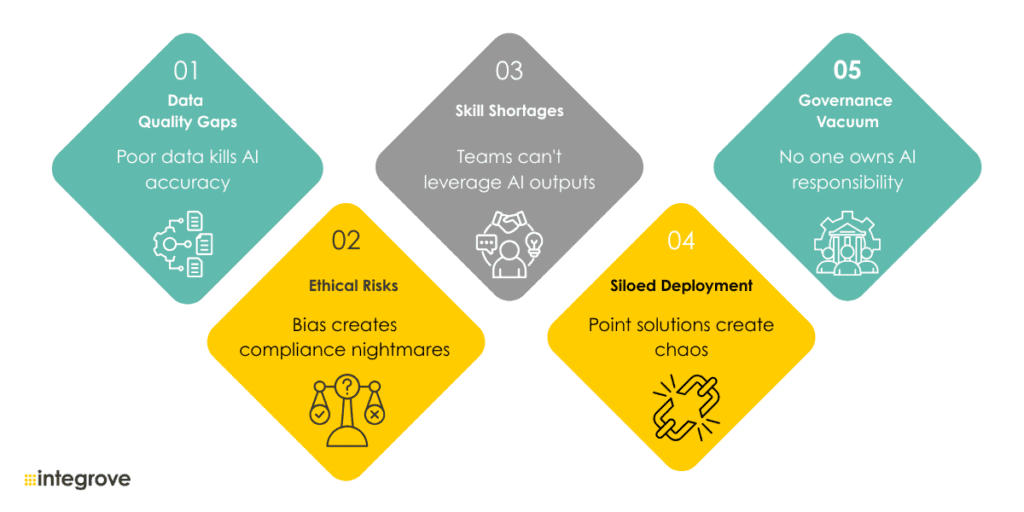
While we have established the need for Integration in AI, it is important to be aware that there are unfortunately some challenges that enterprises may face. Luckily, they are solvable:
- Data Quality Gaps: Poor data kills AI accuracy
Establish strong data governance, cleansing, and integration practices before training or deploying AI models. - Ethical Risks: Bias creates compliance nightmares
Embed bias testing, transparency controls, and ethics reviews into the AI development lifecycle. - Skill Shortages: Teams can’t leverage AI outputs
Upskill teams through targeted training and pair AI tools with clear human-in-the-loop processes. - Siloed Deployment: Point solutions create chaos
Adopt an enterprise AI strategy with shared platforms, standards, and integration architectures. - Governance Vacuum: No one owns AI responsibility
Assign clear AI ownership with defined accountability, policies, and decision rights at leadership level.
Gartner forecasts 40% of enterprise apps embedding AI agents by 2028, demanding enterprise governance now.
The Binary 2026 Choice
Integration of artificial intelligence into business should form a critical part of your strategy. At Integrove, our teams have seen cloud governance and mining clients fail with siloed AI pilots, whilst integrated deployments delivered 3x ROI.
The choice that enterprises face in 2026 is clear: integrate decisively across BPM, Software Development Life Cycle (SDLC), and operations, or watch agile competitors claim your market share. The evidence is overwhelming across academia, enterprise case studies, and analyst forecasts. Integration doesn’t just improve AI performance; it redefines your entire business.
The question isn’t “should we integrate AI?” It’s “how quickly can we integrate across our entire operation?” Fortunately, our experienced consultants are here to team with you to fully integrate with your AI operations.
