


By: Hendrik Louw – Asset Management Consultant
Operational continuity in mining can be disrupted by both sudden failures and the cumulative effect of smaller breakdowns. Effective maintenance tactics as part of early Operational Readiness planning play a critical role in either preventing these failures, detecting them earlier, or enabling faster and more consistent recovery.
Imagine a mining operation that declares it is fully ready for start-up.
All systems reflect that critical equipment is available, maintenance plans are in place, and readiness checklists have been completed. By mid-morning, a critical asset fails.
Maintenance responds immediately, but the failure was neither anticipated nor prepared for. The required spares are not positioned correctly, task execution is inconsistent, and recovery takes longer than expected.
Production is disrupted, not because the operation lacked effort or intent, but because the maintenance tactics shaping system performance were not aligned to operational reality.
This is a common scenario across mining operations. On paper, readiness is achieved. In practice, operational continuity remains fragile.
What are Maintenance Tactics?
Maintenance tactics represent the practical logic behind how an operation manages asset reliability.
They define the “how” and “why” behind maintenance activities, not just the “what”.
In essence, maintenance tactics determine:
- What assets are critical to operational continuity.
- Which failure modes must be prevented, predicted, or tolerated.
- How maintenance tasks are aligned to actual operating conditions.
- How operators and maintainers share responsibility for asset care.
- How spares, tools and resources are positioned before failure occurs.
- How recurring failures are identified and eliminated.
Effective maintenance tactics ensure that decisions are consistent, proactive and aligned with operational risk.
Why Maintenance Tactics Matter for Operational Continuity?
Operational continuity is the ability to sustain safe, stable and predictable production under both normal and unexpected conditions.
Continuity depends on whether the maintenance system can anticipate failure, prioritise the right work and restore equipment without repeatedly forcing the operation into recovery mode.
While production planning defines performance targets, it is maintenance execution and decision-making that ultimately protect continuity.
When maintenance tactics are misaligned, the same patterns tend to appear:
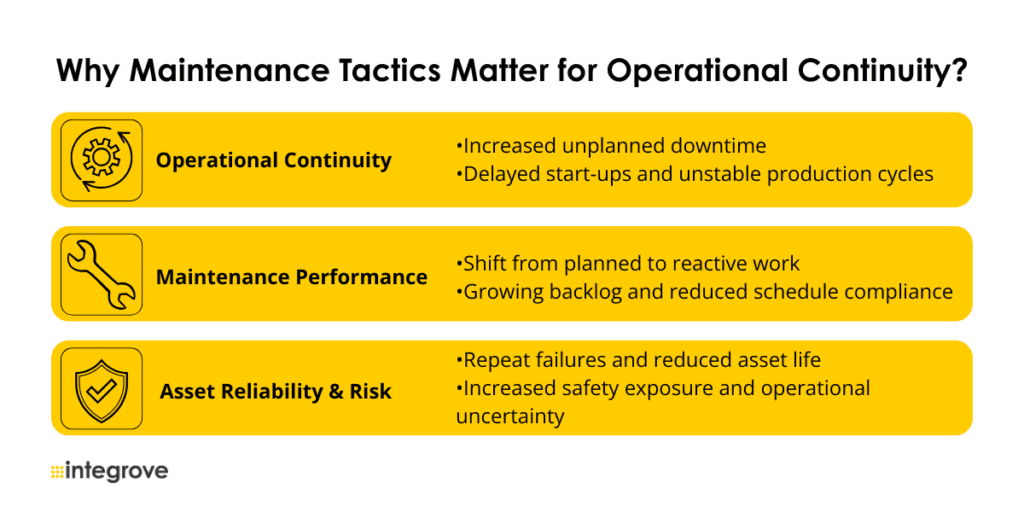
Operational Continuity:
•Increased unplanned downtime
•Delayed start-ups and unstable production cycles
Maintenance Performance:
•Shift from planned to reactive work
•Growing backlog and reduced schedule compliance
Asset Reliability & Risk:
•Increased safety exposure and operational uncertainty
Designing Maintenance for Continuity
Maintenance should not be introduced late in the project lifecycle or under production pressure. A more effective approach is to embed maintenance tactics early into the operational model.
One of the most common issues is that maintenance planning is treated as a downstream activity once the asset is already close to start-up or already under production pressure. By then, the tactic usually becomes a rushed blend of the Original Equipment Manufacturer (OEM) recommendations, inherited routines and whatever the site can realistically cope with in the short term.
This may get the plant running, but it rarely delivers resilience for stable and long-term performance.
A stronger approach is to build maintenance tactics into the continuity model early, while teams still have time to define what the asset needs, what the operating context will demand and what capability the site must have in place.
The practical building blocks are usually very clear:
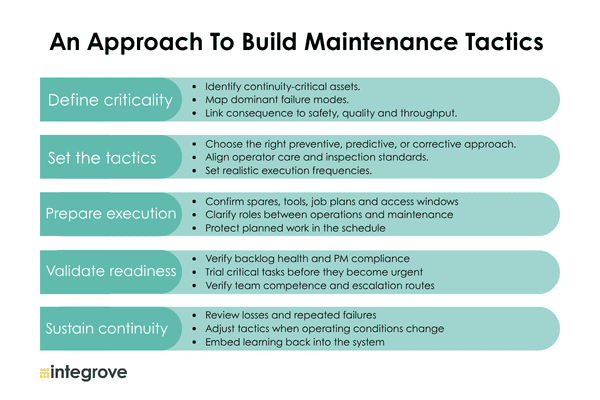
Define criticality
- Identify continuity-critical assets.
- Map dominant failure modes.
- Link consequence to safety, quality and throughput.
Set the tactics
- Choose the right preventive, predictive, or corrective approach.
- Align operator care and inspection standards.
- Set realistic execution frequencies.
Prepare execution
- Confirm spares, tools, job plans and access windows
- Clarify roles between operations and maintenance
- Protect planned work in the schedule
Validate readiness
- Verify backlog health and PM compliance
- Trial critical tasks before they become urgent
- Verify team competence and escalation routes
Sustain continuity
- Review losses and repeated failures
- Adjust tactics when operating conditions change
- Embed learning back into the system
When these elements are in place, maintenance becomes a core enabler for operational continuity, reducing downtime and protecting revenue.
Integrove Case Study: From Failure Intelligence to Operational Continuity
Integrove supported a processing operation that was experiencing recurring disruptions on a critical Primary Mill. A maintenance plan was in place, but it was largely time-based and not really aligned to how the asset was actually failing.
To address this, a structured Failure Modes, Effects and Criticality Analysis (FMECA) was done to better understand the failure behaviour of the mill, which failure modes were most dominant and what their impact was on production.
This shifted the thinking from simply maintaining the equipment to protecting the operation.
The analysis showed that some of the high-impact failure modes weren’t being effectively managed through time-based maintenance alone. Based on this, predictive maintenance was introduced on selected components where early detection could make a real difference.
One example of this was an anomaly detection agent on the Primary Mill, which picked up an increase in girth gear lubrication return pressure. This triggered a closer look, and oil contamination in the system was identified. The oil was drained and replaced before it could lead to failure.
The impact was clear:
- 16 hours of potential loss avoided
- 12.6 hours of downtime risk mitigated (79% impact factor)
- ~4 hours of production preserved
More importantly, this prevented a likely failure that would have had a major impact on production. It’s a good example of what happens when maintenance is aligned to actual failure behaviour, rather than fixed intervals.
Using these insights, maintenance tactics were adjusted:
- Activities were aligned to the dominant failure modes.
- Work was prioritised based on impact on throughput and recovery.
- Predictive monitoring was applied, where it added real value.
This case demonstrates that continuity is not achieved by increasing maintenance effort, but by aligning maintenance tactics to how the system actually fails and recovers.
Ensuring Operational Continuity
Operational continuity is often viewed as a function of execution, planning, or system capability. In reality, it is heavily influenced by something far less visible: the quality of maintenance tactics.
Maintenance is not just repairing equipment. It is one of the clearest drivers of whether a site can operate safely, consistently and without unnecessary disruption to realise and maximise production outputs. That is why maintenance tactics require leadership attention long before the next breakdown forces the conversation.
When maintenance tactics are realistic, disciplined and aligned to the operating context, the benefits extend well beyond the workshop. The operation becomes more predictable, recovery becomes faster, and teams spend less time improvising their way through recurring disruption:
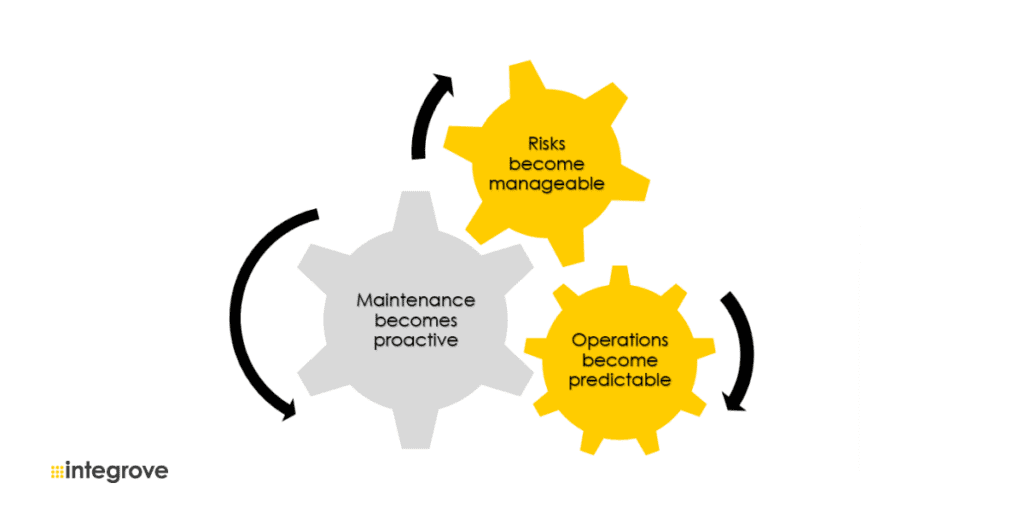
At Integrove, we view maintenance tactics as a strategic operational lever, essential to achieving true operational readiness and long-term performance.
Reliable operations do not come from doing more maintenance. They come from doing the right maintenance for the right reasons.
