


Transforming Cloud Governance: How Automated Access & IaC Framework Secures, Accelerates & Saves Costs
Cloud adoption has become the foundation of digital transformation, but with agility comes responsibility. As organisations scale their cloud environments, two consistent questions emerge: How do we securely govern access, and how do we provision resources consistently without slowing innovation? Integrove’s Platform Engineering has designed an approach that answers both by combining Infrastructure as Code (IaC) with automated access management. This ensures teams move fast, without compromising compliance, auditability, or cost efficiency. We will also highlight some access control errors and which approach works best to counter them.
The Challenge
Operating in the cloud brings agility, but also new risks. Businesses that move fast often find themselves exposed by small mistakes. Below are key challenge categories with real incident references and how this solution addresses them.
Misconfigured Access Controls & Excess Permissions
Here are some real-world examples where misconfigured access controls had a negative impact on businesses and user data:
- Microsoft AI accidentally exposed 38 TB of private data via mis-configured Azure Blob storage, due to an overly permissive SAS token granting “full control” instead of read-only. The Risks of Cloud Misconfiguration: A Case Study of the Microsoft AI Data Leak
- A misconfigured Azure Blob bucket leaked 2.4 TB of customer data through a public endpoint (“BlueBleed” incident).
- In 2022, a platform exposed 30.5 GB of student records because an Azure resource was publicly exposed without proper authentication.
These incidents show how a minor mistake in access permissions can lead to large-scale exposure.
How this approach helps:
- Least privilege enforcement: Only allow users to pick from pre-approved roles (e.g. Reader, Contributor) mapped to resource types.
- Just-In-Time (JIT) access: Production roles automatically expire (via Time to live (TTL) or Privileged Identity Management (PIM), limiting the window of exposure.
- Approval gating + automation: Users cannot bypass the system; the automation only executes valid requests that passed governance.
Drift & Shadow Permissions
As ad-hoc permissions accumulate over time, teams or individuals may be granted access long after it’s needed, creating a “shadow” permissions problem. Audit reports often show that old accounts still have access.
Real-world examples:
- Cloud misconfigurations are often cited as the top cause of security incidents; some reports say misconfiguration accounts for ~23% of cloud security events.
- Analysts point out that “overly permissive access to workloads,” “disabled logging”, and “exposed access keys” are among the most common misconfiguration errors.
How this approach assists:
- Automate revocation via TTL cleanup runbooks so post-provision access is cleaned up automatically.
- No manual accumulation: all grants and revokes go through structured runbooks.
- Reporting/audit log integration ensures you can trace who had access and when it was removed.
Human Error & Name Mismatches Causing Failures

Sometimes flows fail not because of logic errors, but because users enter an incorrect resource name or group. This causes request failures, back-and-forth clarifications, and delays.
Real-world examples:
- In many cloud security articles, one of the vulnerabilities cited is “ineffective identity architecture,” “insecure public configurations,” and “exposed resource names/ APIs.”
- A study, “Stratosphere: Finding Vulnerable Cloud Storage Buckets”, showed how misnamed buckets and poor naming conventions expose resources to guessing.
How this approach assists:
- We provide a single resource catalogue (Excel / Confluence) that lists valid resource names, groups, and types.
- The request form only accepts selections or validated names (dropdown, auto-complete) matching the catalogue.
- This eliminates name mismatches and ensures the pipeline has correct input, reducing failed requests.
Non-Governed Access in Identity (AAD/ App Configurations)
Even if your infrastructure is locked down, misconfigurations in identity or API setup can expose resources.
Real-world examples:
- A misconfiguration in Azure Active Directory allowed unauthorised access to Microsoft’s internal Bing CMS (called BingBang attack). Attackers exploited misconfigured multi-tenant apps to influence Bing results and gain elevated access.
How this approach assists:
- All identity and role assignments flow through your governance pipeline, not manual edits in Azure Active Directory.
- Role assignments are scoped precisely, only to the allowed resource IDs.
No direct scripting by developers; all goes through vetted automation.
Each of these problems has caused real-world incidents, from high-profile data leaks to costly downtime. Traditional fixes often mean adding third-party governance tools, which introduce new license costs and yet another layer of complexity.
Automation Approach
This helps enterprises turn this around with an automation-first framework:
- Infrastructure as Code (Terraform) -consistent, reproducible resource creation.
- Automated Access Management -Just-in-Time access with TTL (Time to live) expiry for Production environments.
- Audit & Logging -Compliance-ready logs and reports for every access grant and revoke.
- Most importantly, this framework works entirely within the Microsoft ecosystem.
- Azure DevOps Pipelines
- Power Automate for orchestration and approvals
- Azure Automation Runbooks
- Azure Monitor / Log Analytics for observability
- SharePoint & Microsoft Forms
This means organisations don’t need to pay for or maintain external providers. Instead, they unlock full governance power using what they already have under their Microsoft licensing agreements.
This creates a secure, scalable, and governed self-service model for cloud adoption.
The Benefits
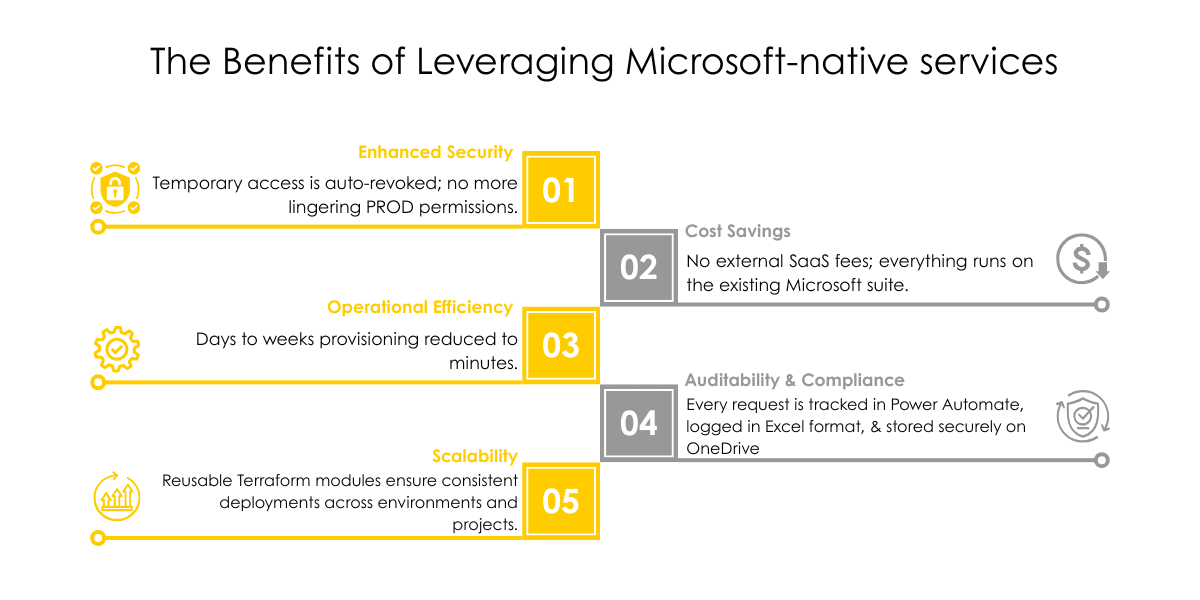
By leveraging Microsoft-native services, enterprises achieve:
- Enhanced Security – Temporary access is auto-revoked; no more lingering PROD permissions.
- Cost Savings – No external SaaS fees, everything runs on the existing Microsoft suite.
- Operational Efficiency – Days to weeks provisioning reduced to minutes.
- Auditability & Compliance – Every request tracked in Power Automate, logged in Excel format, stored in secure folders on OneDrive.
- Scalability – Reusable Terraform modules enable consistent deployments across environments and can also be used by other projects within the enterprise.
Integrove for Cloud Governance
In closing, transforming cloud governance is a critical necessity for secure and scalable cloud operations. By combining Infrastructure as Code with automated access workflows using native Microsoft tools, organisations can eliminate misconfigurations, reduce operational overhead, and enforce least privilege without slowing innovation. This framework not only safeguards cloud environments from costly exposure and drift but also drives efficiency and compliance at enterprise scale. As cloud adoption accelerates, automation-driven governance becomes the foundation for agility, accountability, and cost-effective growth.
