


By: Cathrine Makhubela – Senior Technical Consultant
Projects rarely fail because assets are poorly designed; they fail because people are underprepared to operate them from day one.
In practice, I have seen projects where advanced technology and automation were deployed, yet performance suffered because operators and maintainers were not sufficiently trained. This creates a gap between design intent and operational reality, which often manifests as extended ramp-up periods, increased downtime, higher maintenance costs, and safety risks.
Too often, projects focus heavily on design, equipment specifications, and commissioning milestones, while underestimating the human element. Yet it is people who operate, maintain, and optimise these systems every single day. Operational Readiness (OR) is not about systems being installed; it is about ensuring people are competent, confident, and capable of operating the asset safely, efficiently, and sustainably from the get-go.
Why Training Matters in Operational Readiness
Operational readiness is the structured effort that ensures newly commissioned assets operate safely, efficiently, and sustainably from day one. It bridges the gap between construction completion and stable operations by aligning systems, processes, and most importantly, people.
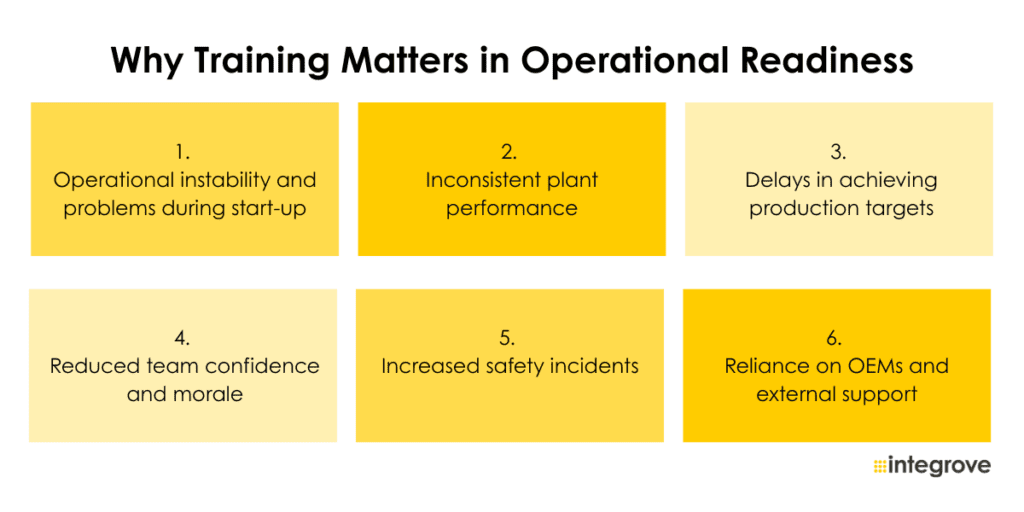
However, launching without robust training is like handing someone the keys to a sports car without explaining the gear-shift pattern. No matter how advanced a process is or how well equipment is commissioned, success ultimately depends on people, their skills, confidence, and ability to perform under real operating conditions. When training is treated as an afterthought, the following consequences become obvious:
How Integrove Enables Operational Readiness Through Training (Use-Case Insight)
This is a challenge Integrove regularly supports clients with, particularly during the critical transition from project delivery into operations.
In many engagements, our mining team is brought in late in the project lifecycle, where assets are nearing mechanical completion, but operational readiness poses a significant risk to a stable start-up. While training activities may exist, they are often generic, disconnected from site-specific operating conditions, or rushed into the final weeks before commissioning.
Our approach starts with understanding the operational needs. We work alongside site leadership to assess critical roles, operating tasks, and system dependencies across manufacturing, maintenance, quality, and safety. From there, we design role-based, scenario-driven training programmes aligned directly to the site’s control systems, procedures, and maintenance strategies.
Rather than focusing solely on classroom learning, training is embedded into the operational readiness framework through system walkdowns, real-world simulations, competency validation, and structured knowledge transfer from project teams to operations. We do this by our integrated OR schedule that aligns with commissioning, normally around C3, also known as cold commissioning, to involve key operational resources for additional training and operate the plant, basically taking over from construction.
By integrating training into readiness planning, rather than treating it as a final deliverable, organisations can:
- Reduce start-up instability
- Accelerate ramp-up to steady-state operations
- Improve operator confidence and decision-making while ensuring safety
- Reduce dependence on OEMs post-handover
We understand that training is not a standalone activity but a strategic enabler of operational readiness, ensuring assets are not just delivered, but successfully operated.
Training as a Foundation, not a Final Step
Too often, training is rushed into the final weeks before commissioning, when teams are already overwhelmed, and learning retention is at its lowest. In an Operational Readiness context, training should be embedded into the overall readiness strategy from day one. This includes:
- Skills assessments to identify gaps
- Training needs analysis aligned with job roles
- Competency frameworks tailored to operational demands
- Targeted development plans for real-world readiness
When training needs are understood early in the project lifecycle, organisations can design and deliver structured programs that build competency progressively, rather than scrambling to train teams right before go-live.
The Impact of Doing it Right
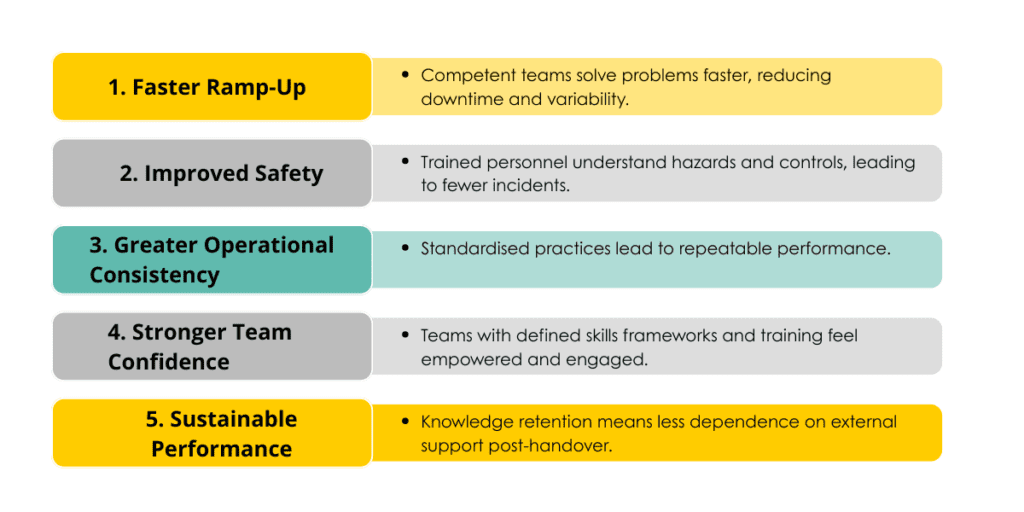
When organisations prioritise training within their Operational Readiness strategy, the following benefits are clear:
Data That Reinforces the Practice
Industry research shows that organisations that invest in workforce capability experience higher productivity, lower incident rates, and faster stabilisation post go-live. According to leading industry research, learning maturity has a direct impact on performance. Representative findings include:
- A 2025 Harvard Business Review report mentioned that up to 17% productivity gains and 21% profitability improvements in organisations with strong learning cultures.
- McKinsey & Company in 2021 further highlighted a 30–40% faster ramp-up through structured capability programmes.
- In 2019, Deloitte linked mature training systems to significantly lower safety incident rates.
Training in the Context of Operational Readiness
Operational Readiness is multi-dimensional; it includes systems, procedures, risk mitigation, and people. But in my experience, the people dimension often dictates success or failure. A comprehensive operational readiness program should include:
- Role-based competence frameworks: defining what each Role must know before go-live.
- Hands-on training and simulation exercises: where operators practise real-world scenarios.
- Knowledge transfer mechanisms: from project teams to operations teams.
In real projects, I’ve seen teams with excellent designs still struggle during handover because training was rushed or superficial. Conversely, well-trained teams consistently outperform expectations, adjust more quickly to variability, and handle troubleshooting with confidence.
What Effective Training Looks Like
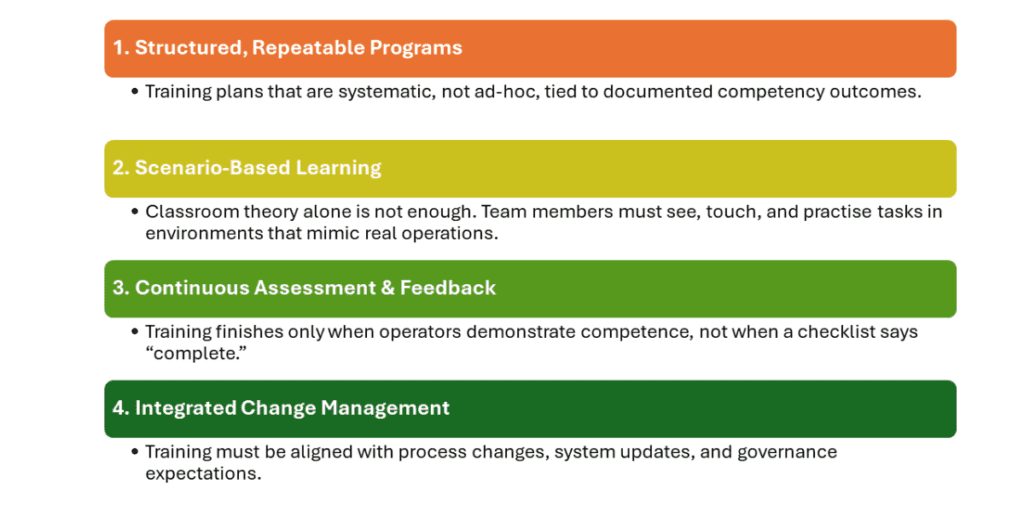
Well-structured training directly impacts productivity, reliability, safety, and cost performance. Training within an operational readiness framework must be role-based, scenario-driven, and continuously validated. It should address not only technical skills, but also decision-making, problem-solving, and cross-functional collaboration. Here are the pillars of training that drive readiness:
A robust training program begins with assessment. Workshops with relevant stakeholders help define the specific skills and knowledge required to operate and maintain new assets effectively. This structured approach forms the basis of a training plan that is measurable, role-specific, and aligned with operational objectives.
Importantly, this is not a “one-size-fits-all” activity. It must be customised to the asset’s context, the technology involved, and the workforce’s existing capabilities. The diagram below is a structured framework outlining how training should be systematically used to achieve sustainable operational readiness.
A Structured Framework to Achieve Sustainable OR
Define Readiness:
- Identify Critical RolesDefine
- Role-Based Competencies
- Link Skills to Business KPIs
Design Training:
- Role-Based Learning Pathways
- SOP, Process Alignment, Safety & Risk Management
- Training Needs Analysis
Deliver Training:
- Classroom & On-the-Job Training
- Simulations & Real Life Screnario
- Shadowing Experienced Operators
Validate Readiness:
- Competency Assessments
- Scenario Testing
- Formal Readiness Sign-Off
Sustain Performance:
- Continuos Improvement
- Refresher & Upskilling Programs
- Lessons Learned Integration

Training is a Strategic Enabler for Successful Operational Readiness
Training is a strategic enabler of safety, performance and value. In my own journey, I’ve learned that no amount of design excellence and successful project delivery can substitute for a well-trained team that knows how to respond when theory hits reality. When training is integrated into operational readiness planning, executed with purpose, and supported by leadership, organisations unlock the full potential of their assets and their people. Operational readiness is not achieved at handover; it is achieved when people are ready to safely and independently own, operate, and optimise the asset.
