


By: Shaneé Swanepoel – Senior Application Managed Services Lead, Integrove.
When I moved from change management into leading AMS teams (Application Managed Services) I thought I was shifting careers. It turned out I was simply changing the soundtrack: same chaos, different instruments.
Whether you are guiding users through transformation or managing a production outage, success depends on one thing: how well you help people remain steady in uncertainty.
Enterprise systems are more complex than ever. Integrations, dependencies, and data flows mean a single failure can ripple across operations. Yet many organisations still treat AMS as a reactive function measured only by ticket volumes and SLAs (service level agreements). That mindset no longer fits.
According to AMS, success is now defined by predictive operations, human-centred automation, and business alignment, not just uptime. Modern AMS teams must anticipate issues, interpret data, and maintain trust amid constant change.
The technology matters, but the people managing it matter more. Analysts burn out, clients lose confidence, and teams start chasing symptoms instead of solving causes.
Coming from a change-management background, I’ve seen how the same techniques used to drive adoption can stabilise service delivery. Communication rhythms, empathy, and behaviour mapping don’t just make projects smoother; they make operations more resilient.
“The best AMS leaders aren’t technologists; they’re change managers in disguise.”
Three Pillars of Modern AMS Leadership
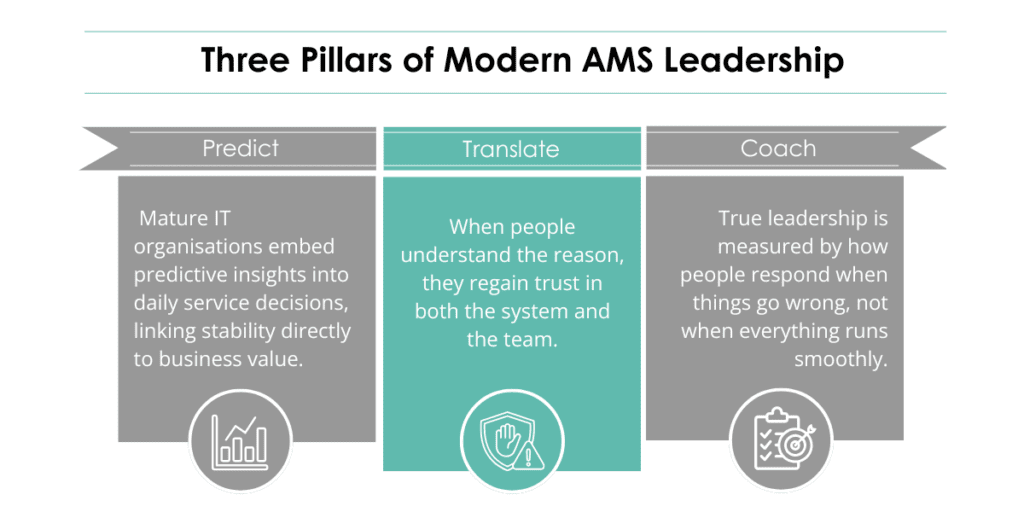
- Predict, Don’t React
Shift from firefighting to foresight. It is important to use data to identify recurring patterns, not just incidents. Trend analysis and behavioural mapping turn small signals into early warnings. McKinsey’s “Leading Through Transformation in IT Operations” reinforces this: mature IT organisations embed predictive insights into daily service decisions, linking stability directly to business value.
- Translate, Don’t Just Fix
AMS leadership is communication. Explaining why something failed builds credibility faster than quietly resolving it. When people understand the reason, they regain trust in both the system and the team.
- Coach, Don’t Command
Analysts mirror their leader’s tone. A calm, consistent approach creates confident teams that think critically instead of mechanically. True leadership is measured by how people respond when things go wrong, not when everything runs smoothly.
Leading AMS teams for positive change
Throughout my time leading AMS, I’ve realised you can tell a lot from the tone of a ticket. The wording, the urgency, even the punctuation reflect how a user feels in that moment.
Sometimes what seems minor to us feels catastrophic to them. It’s easy to get lost in systems and forget the human experience behind every log. My background in change management helps me see beyond the issue and into the user’s reality. I’ve implemented their systems, worked beside their teams, and witnessed how technology shapes their day.
The PROSCI ADKAR Model for organisational change has always resonated with me — awareness, desire, knowledge, ability, and reinforcement. Those same stages apply when leading AMS teams. It’s not just about resolving the issue; it’s about helping users rebuild confidence.
That insight changes how I lead and how I communicate. It’s something Integrove does exceptionally well: we put our hearts into our technology, ensuring every interaction keeps its human touch.
Integrove’s practical playbook
- Establish proactive communication routines with clear ownership for each client stream.
- Analyse recurring incidents for behavioural or process patterns, not only technical ones.
- Pair automation with accountability; dashboards must drive action, not just visibility.
- Build your team’s soft-skills muscle through active listening and structured debriefs.
- Treat every outage as a trust-building opportunity instead of a failure.
The next evolution of AMS isn’t about faster resolutions or better dashboards. It’s about leadership that balances intelligence with empathy. Change management taught me to guide people through uncertainty, not away from it, and that mindset defines how Integrove delivers Managed Services today. We combine intelligent monitoring with human-centred leadership to create stability that scales.
Because at Integrove, we don’t just manage change, we make it manageable.
