


By: Thato Aphane – Junior Business/ Systems Analyst
In software delivery, we often celebrate the visible outcomes: clean code, elegant architecture, and feature-rich platforms. Yet decades of industry research and delivery experience point to a less visible truth.
Software projects don’t succeed or fail because of technology. They succeed or fail because of communication.
Anyone who has worked as a Business or Systems Analyst has experienced this moment. A room full of agreement, nodding heads, and apparent consensus, followed by entirely different interpretations once the meeting ends. This pattern is not anecdotal. Studies such as the Standish Group’s CHAOS Reports consistently identify unclear requirements and poor communication as leading causes of software project failure, often ranking higher than technical complexity itself.
Communication is not a supporting activity in software projects. It is the real deliverable.
The Hidden Complexity of Bespoke Software
Bespoke software development offers no templates to hide behind. Every project begins with a blank page shaped by unique business processes, systems, people, and constraints.
Research in requirements engineering has repeatedly shown that when clarity is missing early, assumptions quietly replace understanding, leading to costly rework later in the lifecycle (IEEE Software, Requirements Engineering studies). In custom software, where no two projects are alike, these assumptions compound faster and hurt more.
Clarity, therefore, is not a “nice to have.” It is foundational to successful delivery.
Communication Is Not a Meeting or a Document
In many organisations, communication is mistaken for activity, like meetings booked, documents produced, messages sent. But as Agile thinking has emphasised for over two decades, individuals and interactions matter more than processes and tools (Agile Manifesto, 2001).
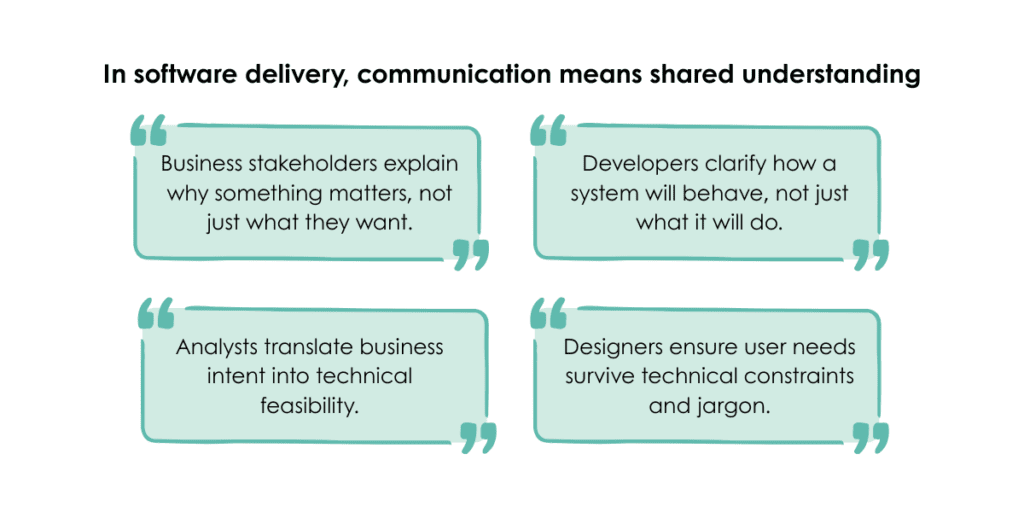
In software delivery, communication means shared understanding.
Shared understanding exists when:
- Business stakeholders explain why something matters, not just what they want.
- Developers clarify how a system will behave, not just what it will do.
- Analysts translate business intent into technical feasibility.
- Designers ensure user needs survive technical constraints and jargon.
When these perspectives align, communication becomes the invisible glue holding the project together.
The Real Cost of Miscommunication
Multiple global studies reinforce that miscommunication is among the most significant contributors to project failure. The Project Management Institute’s Pulse of the Profession reports consistently show ineffective communication as a primary factor behind missed objectives and failed initiatives.
The real damage, however, is not confusion; it is misalignment.
- Teams build solutions that solve the wrong problem.
- Stakeholders assume progress means understanding.
- Features are reworked not because they were poorly built, but because they were poorly understood.
McKinsey & Company’s research on failed IT transformations highlights this same issue. Misalignment between business and technology teams dramatically increases delivery risk, regardless of tooling or budget.
The Business Systems Analyst as the Bridge Between Worlds
This is where Business and Systems Analysts become essential, not as documentation specialists, but as facilitators of understanding.
While tools and automation (including AI) can support analysis, they cannot replace the human ability to listen, challenge assumptions, and recognise when alignment is superficial. As Frederick Brooks famously noted in The Mythical Man-Month, the hardest problems in software development are rarely technical; they are problems of communication and coordination.
Our role is to bridge:
- Business outcomes and system architecture
- Stakeholder vision and developer implementation
- The world of “why” and the world of “how”
These bridges remain human by necessity.
Communication as a First-Class Deliverable

If communication were treated with the same importance as design or development, projects would look very different:
- Alignment plans alongside project plans
- Discovery workshops are valued as highly as sprint reviews
- Living documentation that evolves with understanding
- Visual storytelling, journey maps, process flows and prototypes to make the future visible early
High-performing organisations already do this. PMI research shows that organisations investing in stakeholder engagement and communication maturity significantly outperform their peers.
The Takeaway
Every line of code tells a story, but the story begins with a conversation.
Success is not measured solely by features delivered. It is measured by the shared understanding sustained throughout the project.
Communication is not a soft skill. It is a strategic capability.
Code can be rewritten. Designs can change. Trust and clarity, once lost, are far harder to recover.
The best software projects deliver more than working systems. They deliver alignment, clarity, and shared purpose. Principles that continue to guide successful bespoke software delivery and remain central to how Integrove approaches its work.
Where has miscommunication cost you the most?
