


By: Gordon Matshwane – Senior Software Engineer
The State of Mobile Development in 2026: Navigating a Mature Yet Evolving Landscape
Mobile development has reached a fascinating inflexion point. What began as a wild west of emerging platforms and experimental approaches has matured into a sophisticated ecosystem with established patterns, powerful tools and clear best practices. Yet beneath this stability lies a current of continuous innovation that keeps reshaping how we build mobile experiences.
The Cross-Platform Revolution Has Arrived
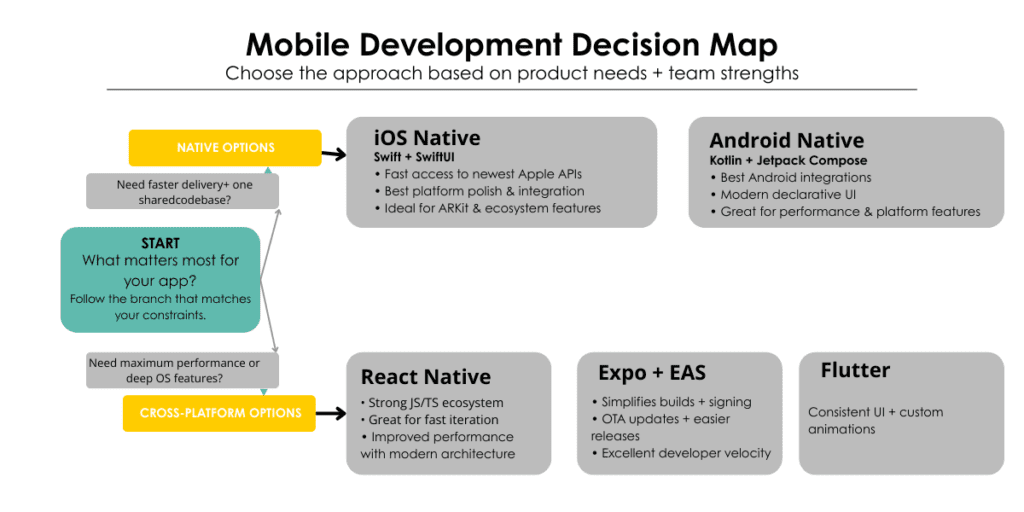
The most significant shift in mobile development over the past few years has been the mainstream adoption of cross-platform solutions. React Native, NativeScript, Flutter and more recently frameworks like Expo and Tauri have moved from “interesting alternatives” to legitimate first choices for many development teams.

Flutter has gained remarkable traction. Google’s UI toolkit now powers apps from major companies like BMW, Toyota and eBay. Its single codebase approach, combined with near-native performance and a rich ecosystem of packages, has made it particularly attractive for startups and enterprises looking to maximise their development efficiency.
React Native continues to evolve, with the New Architecture (Fabric and TurboModules) finally reaching stable release. This overhaul addresses many of the performance concerns that previously plagued the framework, bringing it closer to native performance while maintaining its developer experience advantages.
Native Development: Far From Dead
Despite the cross-platform surge, native development remains vibrant and essential. Apple’s SwiftUI and Google’s Jetpack Compose have revolutionised native development by bringing declarative UI paradigms to iOS and Android, respectively. These frameworks make native development more approachable while unlocking platform-specific capabilities that cross-platform solutions still struggle to match.
SwiftUI’s maturation has been particularly noteworthy, with Apple continuously expanding its capabilities and improving its performance. The framework now handles complex layouts and animations with ease, while providing seamless integration with the broader Apple ecosystem.
On Android, Jetpack Compose has similarly transformed the development experience. The move away from XML layouts to a fully Kotlin-based UI framework has eliminated many of the pain points that made Android development cumbersome, while opening new possibilities for dynamic and interactive interfaces.
The AI Integration Wave
Perhaps no trend has impacted mobile development more dramatically than the integration of artificial intelligence capabilities. The widespread adoption of large language models and on-device AI processing has created entirely new categories of mobile applications.
Apple’s introduction of Core ML and Google’s ML Kit have made it straightforward to integrate sophisticated AI features directly into mobile apps. From real-time image recognition to natural language processing, capabilities that once required cloud processing and significant infrastructure can now run entirely on-device.
The rise of AI-powered development tools has also transformed the development process itself. GitHub Copilot, Cursor and similar tools have become indispensable for many mobile developers, dramatically accelerating the coding process and helping developers tackle unfamiliar APIs and frameworks.
Performance and User Experience Focus
Mobile users have become increasingly sophisticated in their expectations. The bar for what constitutes acceptable performance has risen significantly, with users expecting instant load times, smooth animations and responsive interfaces regardless of device capabilities.
This has led to renewed focus on performance optimisation techniques. Lazy loading, code splitting and efficient state management have become standard practices. The concept of “performance budgets” has gained traction, with teams setting specific metrics for load times, bundle sizes and memory usage.
Battery life optimisation has also become a critical consideration. With users spending more time on mobile devices than ever before, apps that drain battery are quickly deleted. This has driven the adoption of more efficient programming patterns and careful consideration of background processing.
The Security Imperative
Security concerns have reached new heights in mobile development. High-profile data breaches and increasing regulatory scrutiny have made security a top-tier consideration for all mobile applications.
The implementation of app transport security, biometric authentication and encrypted storage has become standard practice. Frameworks like iOS’s CryptoKit and Android’s security library provide robust tools for implementing these features, but they require careful implementation to be effective.
Zero-trust architecture principles are increasingly being applied to mobile development, with apps designed to verify and validate all interactions rather than assuming trust based on network location or device state.
Development Workflow Evolution
The mobile development workflow has been revolutionised by advances in continuous integration and deployment. Services like Fastlane, CircleCI and GitHub Actions have made it possible to automate the entire build, test and deployment process.
App distribution has also evolved significantly. TestFlight and Google Play Console have improved their beta testing capabilities, while services like Firebase App Distribution provide additional options for internal testing and staged rollouts.
The introduction of tools like Expo’s EAS (Expo Application Services) has simplified many traditionally complex aspects of mobile development, from managing certificates and provisioning profiles to handling over-the-air updates.
Emerging Technologies and Future Directions
Several emerging technologies are poised to reshape mobile development in the coming years. Augmented reality capabilities, once the domain of specialized apps, are becoming mainstream features. Apple’s ARKit and Google’s ARCore have made AR development more accessible, while frameworks like React Native’s AR capabilities bring these features to cross-platform development.
Progressive Web Apps (PWAs) continue to blur the line between web and native applications. While they haven’t replaced native apps as some predicted, they’ve carved out a significant niche, particularly for content-focused applications and businesses looking to reduce development costs.
The rise of foldable devices has introduced new design challenges and opportunities. Developers must now consider how their applications behave across multiple screen configurations, leading to more flexible and adaptive design approaches.
Challenges and Pain Points
Despite these advances, mobile development still faces significant challenges. Platform fragmentation remains a persistent issue, particularly on Android, where the diversity of devices, screen sizes and OS versions creates testing and compatibility challenges.
App store policies and review processes continue to be sources of frustration for developers. The sometimes-unpredictable nature of app reviews can delay releases and require last-minute changes that impact development schedules.
The increasing complexity of mobile ecosystems has also raised the barrier to entry for new developers. While tools have become more powerful, they’ve also become more complex, requiring developers to master an ever-growing stack of technologies and frameworks.
The Path Forward
Looking ahead, mobile development appears to be entering a phase of consolidation and refinement rather than revolutionary change. The fundamental platforms and approaches have stabilised, allowing developers to focus on building better experiences rather than constantly adapting to new paradigms.
The continued evolution of cross-platform frameworks suggests that the efficiency gains they provide will make them the default choice for many projects, with native development reserved for applications requiring platform-specific features or maximum performance.
The integration of AI capabilities will likely become as routine as integrating a database or implementing user authentication. As these tools mature and become more accessible, they’ll enable developers to create increasingly sophisticated and personalised user experiences.
Mobile development in 2026 represents a mature field that has learned from its growing pains while maintaining the innovation and creativity that made it exciting in the first place. For developers entering the field or looking to advance their careers, the opportunities have never been greater, but the expectations for quality, performance and user experience have never been higher either.
The state of mobile development is strong, sophisticated and full of potential. The challenge now is not learning how to build mobile apps but learning how to build mobile apps that truly matter to users in an increasingly crowded and competitive landscape. That is why Integrove’s Enterprise Application Development team is here to help decide how to build your applications the best way.
