


By: Mathan Ramadurai
Natural language agents can now understand requests like “issue a partial refund and update the ticket,” but enterprises don’t just need good conversations; they need governed changes in real systems. The hard part is turning conversation into action across fragmented apps, legacy workflows, and strict policies without breaking compliance or reliability. That gap between chat and action is where many AI initiatives stall.
Enterprise APIs are the bridge. They are well-designed, capability-oriented APIs that give agents a clear, safe surface to read, simulate, and execute tasks end-to-end. They encode guardrails, authentication and fine-grained scopes, approvals and policy checks, idempotency, and audit trails so every step is verifiable and reversible. Patterns like async jobs, event confirmations, and event-driven triggers make long-running and proactive work dependable. Emerging standards such as the Model Context Protocol (MCP) and Agent-to-Agent (A2A) exchange help models reliably discover and invoke tools across stacks. APIs turn an AI assistant into an AI agent by granting it the powers to read from and write to business applications.
With an API-first foundation, agents become trustworthy operators for CRM, ERP, HR, finance, and support, resetting passwords, issuing credits, processing orders, or orchestrating supply chain updates at machine speed, with human-grade governance.
Key Roles of APIs in Agentic AI

The infographic below outlines the key roles APIs play in enabling agentic AI: providing live data access, executing actions, orchestrating multi-step processes, reacting to events in real-time, and standardising how capabilities are exposed and governed. Together, these roles transform agents from helpful advisors into accountable operators that can be trusted in production.
MCP and A2A
What is MCP (Model Context Protocol)
MCP defines a universal interface for connecting AI agents (LLM-based applications) with external tools, data sources, and services. In an MCP architecture, developers can implement the following:
MCP Servers: Essentially adapters that expose some backend tool or data via the MCP standard (often over JSON-RPC). An MCP server might wrap a database, an enterprise app, a SaaS API, or even custom logic.
MCP Clients: AI assistant or agent environment that connects to one or more MCP servers. The MCP client (the AI Agent) can discover available tools, invoke them with parameters, and receive results in a standardised format. MCP uses a similar client-server pattern and JSON-RPC messaging.
What is A2A (Agent-to-Agent Protocol)
In modern AI applications, complex tasks often require the expertise of multiple specialised agents. For example, planning a trip might involve agents specialising in flight booking, hotel recommendations, and local activities. Without a standardised protocol, each of these agents would need custom integration code to communicate with each other, leading to inconsistent communication patterns, incompatible data formats, and difficult maintenance and updates.
A2A solves these issues by establishing standard ways for agents to discover each other’s capabilities, exchange information, process tasks collaboratively, handle errors and exceptions
MCP and A2A together
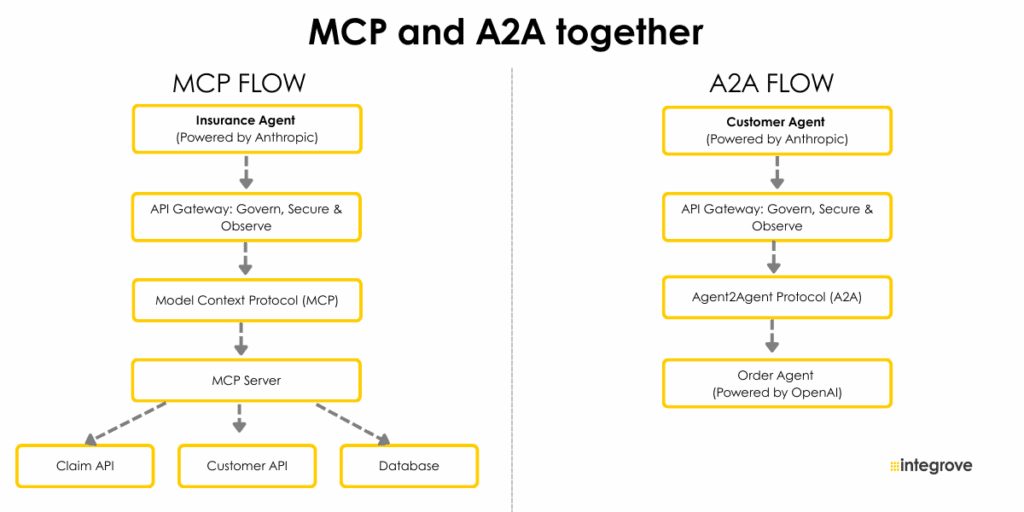
- MCP: Focuses on how a natural language agent communicates with tools and resources (like APIs, databases, and knowledge sources). Think of MCP as how a mechanic interacts with their tools.
- A2A: Focuses on how complete agents (each containing an LLM plus tools) communicate with each other. Think of A2A as how a mechanic communicates with customers or parts suppliers.
If an agent is like a car mechanic (LLM) with their toolbox (tools connected via MCP), then A2A defines how this car repair person communicates with customers, parts suppliers, and other specialists.
API Architecture evolution for Agentic AI
A layered architecture decouples front-end experiences from heterogeneous back-end systems via a governed API layer and an API management plane.
The same APIs that power mobile/web apps now enable agentic experiences (commerce, sales, service agents), with policy, security, and observability enforced centrally.

User Experience
Both app-based experiences (mobile and web/SaaS) and agentic experiences (task-oriented Commerce, Sales, Service agents) use the same domain APIs for CRUD and workflows; agents read data and perform actions like creating orders, adjusting prices, or updating customers, relying on catalogue/discovery to find available tools and on access controls, quotas, and auditability to operate safely.
API Management (control plane)
API Management is a unified control plane that standardises design and discovery, secures and governs access, mediates and optimises traffic and payloads, equips developers with tooling and testing, enforces observability and compliance, and supports monetisation and secret management, ensuring reliable and auditable APIs for apps and agents.
API Layer (data and capability plane)
Domain APIs such as Customer, Product, Price, and Order provide clean, stable contracts that abstract heterogeneous backends, enforce consistent schemas and error models with cursor pagination and idempotent writes, embed business logic to aggregate/join data across sources, expose hooks for long-running jobs, webhooks, and events, and act as the governed, auditable tools agents use to read state and execute actions.
Backend Systems
Heterogeneous systems (SAP, on-prem SQL, other databases, VMs/services). The API layer mediates to these systems, insulating apps/agents from vendor-specific complexity and change.
End-to-end flow (example: agent updates an order)
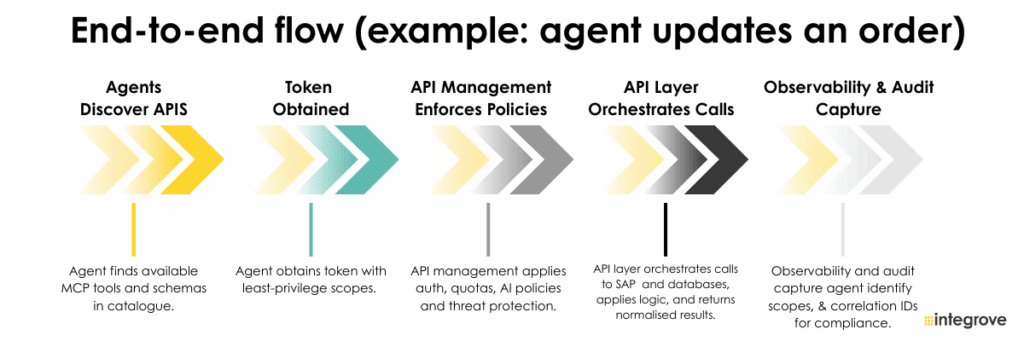
Enterprise APIs are the missing link that turns conversational intent into governed action, giving agents safe, discoverable, and auditable tools to read, plan, and execute across core systems. Anchored by an API first architecture, strengthened by MCP for tool connectivity and A2A for agent collaboration, and enforced through a robust control plane for security, compliance, and observability, enterprises can run long-running and event-driven workflows reliably at scale. The result is autonomous productivity with least privilege access, built-in guardrails, and end-to-end monitoring, delivering speed without sacrificing trust.
The hardest problems with API-powered agents aren’t model prompts. They are security and governance. In my next article, I’ll share key security and governance considerations for Agentic AI so you can ship safely in regulated environments.
Ready to enable Agentic AI from conversation to action that transforms your business? Wherever you are, Integrove helps you move faster and smarter. Reach out to our team to discuss your roadmap and speed up your API-powered Agentic AI delivery.
