


By Zesulile Ngobese – Senior Software Engineer, Integrove
Modern safety management requires more than incident forms and periodic reporting. Organisations operating across multiple sites need real-time visibility, structured reporting, and scalable systems that can grow with operational complexity.
While working on a delivery team at Integrove, I contributed to building a high-scaling on-site incident management solution powered by SAP Business Technology Platform (SAP BTP).
The platform enabled us to create a secure, scalable, and extensible safety solution that transformed how incidents were reported, analysed, and monitored across sites.
From an engineering perspective, the experience reinforced an important realisation:
Cloud-native platforms like SAP BTP allow teams to move quickly while still maintaining the architecture, governance, and scalability expected in enterprise systems.
The Stakes & Context (Problem)
Many organisations still rely on manual processes, spreadsheets, or disconnected systems to track safety incidents. This leads to several challenges such as delayed incident reporting, limited visibility across sites, inconsistent data capture and more. In safety-critical environments, these delays can directly affect risk mitigation and operational continuity.
To solve this challenge, our team needed a platform capable of:
- Rapid application development
- Secure enterprise authentication
- Scalable cloud infrastructure
- Integration with analytics and reporting systems
This is where SAP BTP provided the foundation we needed. Scalable enterprise systems require strong architecture, integration capabilities, and modern platforms that support evolving business needs.
Point of View
“Enterprise cloud platforms like SAP BTP succeed when teams combine platform capabilities with disciplined engineering practices.”
Rather than relying purely on platform features, the success of this solution came from combining the following:
- Cloud-native architecture
- Modular service design
- Scalable APIs
- Strong authentication and DevOps pipelines
The Framework: How We Delivered a Scalable Safety Solution
1. Building a Cloud-Native Backend with CAP
The backend services were built using the SAP Cloud Application Programming Model (CAP) with Node.js. The official documentation for SAP Cloud Application Programming Model explains how CAP enables developers to build enterprise-grade services using domain-driven design and service-based architectures:
CAP allowed us to design a clean domain model for safety incidents, including:
- Incident records
- Locations and operational sites
- Risk classifications
- Personnel and reporting users
Using CAP enabled us to quickly expose services through OData APIs, allowing the frontend to interact seamlessly with backend services. The modular service architecture also made it easier to scale components independently when usage increased.
2. Delivering a Responsive User Experience
For the user interface, we used React to build a responsive and intuitive reporting experience.
The design focused on the real users of the system:
- Field workers
- Safety officers
- Site managers
Key usability considerations included the following:
- Guided incident reporting workflows
- Mobile-friendly interfaces for on-site use
- Clear validations to ensure accurate data capture
- Simple dashboards for monitoring safety events
This design helped ensure fast reporting with minimal friction, even in busy operational environments.
3. Secure Authentication and Identity Management
Security was a critical requirement because incident data can contain sensitive operational information.
Authentication was implemented using Microsoft Azure Active Directory, integrated into the platform through enterprise authentication services.
This allowed us to implement the following:
- Single Sign-On (SSO)
- Role-based access control
- Secure access across corporate environments
By leveraging enterprise identity infrastructure, we ensured the solution aligned with existing corporate security policies.
4. Continuous Integration and Delivery
To support reliable deployments and version management, our pipeline leveraged Microsoft Azure DevOps services including Azure Artifacts.
This allowed the team to implement the following:
- Versioned dependencies
- Automated build pipelines
- Controlled deployments across environments
- Faster release cycles without sacrificing stability
A strong DevOps foundation ensured that improvements could be shipped quickly while maintaining quality.
Mini Case Study: Delivering Safety at Scale
Situation
A client struggled with slow and inconsistent incident reporting across multiple sites. Safety teams relied on manual processes and fragmented systems, which created delays in risk reporting and compliance documentation.
Intervention
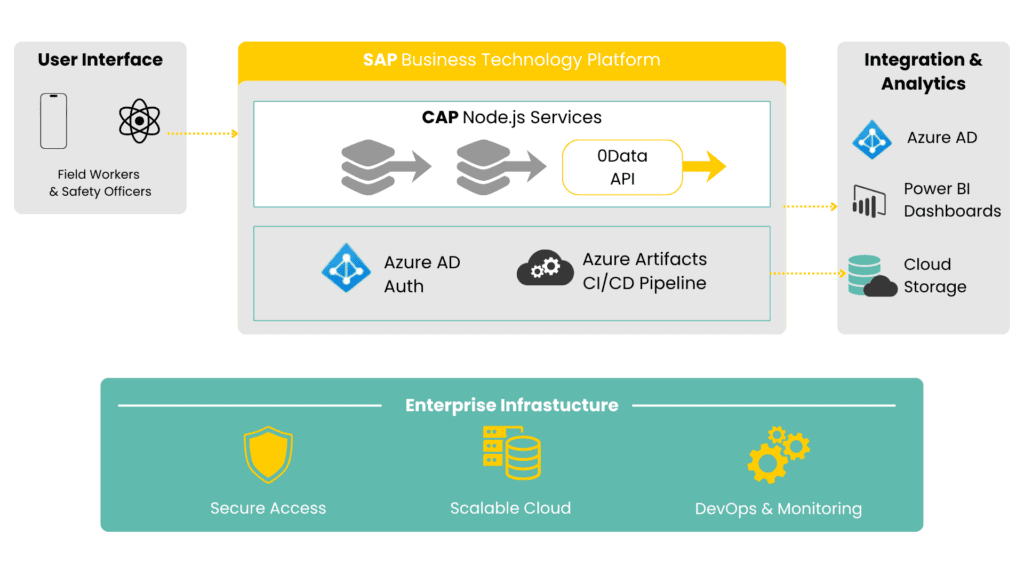
Working as part of a multidisciplinary delivery team, we built a cloud-based incident management solution on SAP BTP that included:
- A React-based incident reporting interface
- Backend services built with Node.js CAP
- Secure authentication through Azure AD
- Centralised data storage and service APIs
- Cloud deployment through SAP BTP
High-Scaling On-Site Incident Solution with SAP BTP:
Outcome
The platform delivered measurable improvements:
- Incident reporting became immediate and standardised
- Data accuracy improved across sites
- Safety teams gained real-time visibility of risk areas
- Reporting processes were significantly accelerated
- The platform scaled easily as adoption increased
Lesson
Enterprise platforms like SAP Business Technology Platform deliver the most value when cloud capabilities and strong engineering practices work together.
The technology alone doesn’t guarantee success—architecture and collaboration do.
Practical Playbook for Organizations Considering SAP BTP
Organizations looking to modernise safety and operational workflows can benefit from a few key practices:
✔ Start with a high-impact workflow such as safety incidents or inspections
✔ Design API-first architectures to enable future integrations
✔ Implement enterprise authentication early
✔ Focus on user experience for field workers
✔ Integrate analytics and reporting capabilities from the start
✔ Build with scalability in mind, even in early versions
These principles help ensure the platform can grow alongside business needs.
Cloud platforms are reshaping how organisations deliver operational software. According to the official overview of SAP Business Technology Platform, the platform provides integrated capabilities for application development, data management, integration, and analytics, allowing organisations to build scalable enterprise solutions on a unified cloud platform.
My experience building a safety solution on SAP Business Technology Platform demonstrated how the platform enables teams to develop secure, scalable, and extensible enterprise applications while maintaining engineering rigor.
When used strategically, SAP BTP becomes more than just infrastructure, it becomes a foundation for innovation and operational intelligence.
For organisations looking to modernize safety systems, incident reporting, or operational workflows, platforms like SAP BTP provide the tools needed to build future-ready enterprise solutions.
