


AI in CX Done Right: Seamless Journeys, Real Empathy, & Transparent Engagement
By: Leatitia Smits
Artificial Intelligence (AI) and Customer Experience (CX) easily go hand-in-hand. AI can improve CX by increasing speed, accuracy, and relevance. However, customer acceptance depends on transparency and ethical use. Salesforce research shows that 72% of customers want to know when they are speaking with an AI agent, and 71% are more protective of personal data than before. These findings show that customers support AI when it is clear, fair, and improves convenience without sacrificing trust. To achieve this, you should prioritise responsible design by ensuring disclosure, data protection, and governance across all AI interactions.
Why AI in CX Still Needs People
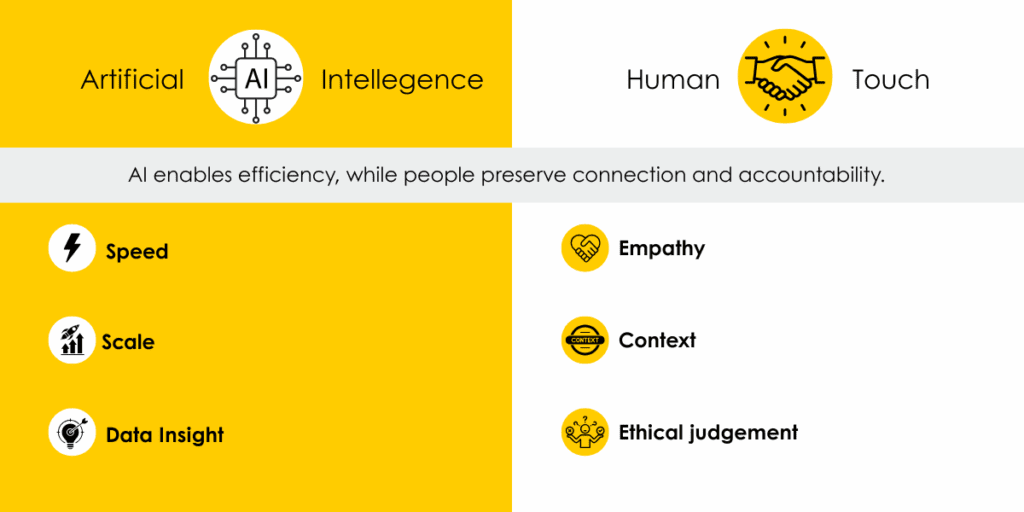
AI improves scale and efficiency, but empathy, judgment, and context remain distinctly human strengths, at least for now. While automation can streamline workflows, it can’t replace the ability to read nuance, reassure customers, or manage ethical trade-offs. The European Union’s Artificial Intelligence Act requires organisations to disclose AI involvement, and ISO/IEC 42001 provides structure for governance and accountability. Both frameworks promote a responsible balance between automation and human oversight. These standards signal a shift from ‘deploy quickly’ to ‘deploy responsibly.’ In practice, AI should support your teams by offering data-driven insights and freeing time for relationship-building, not replacing meaningful interaction.
Hyper-Personalisation That Customers Actually Value
Hyper-personalisation is where data meets empathy and can build loyalty when applied with consent and accuracy. McKinsey’s findings show that AI-driven personalisation can increase customer satisfaction by up to 20% and reduce cost to serve by 20–30%. However, these outcomes depend on how personalisation is applied. These benefits arise when organisations use verified, permission-based data to deliver relevant insights or offers. Unconsented or excessive use of data, by contrast, can undermine trust. When AI uses expected data like purchase or service history to tailor offers, customers view the experience as relevant and supportive. In South Africa, the Protection of Personal Information Act POPIA provides a regulatory safeguard here, ensuring that brands handle personal data ethically and transparently. True personalisation happens when you use data with permission to make experiences intuitive, not manipulative.
Omnichannel Journeys That Feel Seamless
Today’s customers move fluidly between channels: starting a query on chat, switching to email, and ending on a call. Gartner predicts that digital-first options such as self-service and chat will surpass traditional channels in value by 2027. AI can link these channels by preserving context so interactions feel continuous, enabling customers to pick up where they left off without repeating themselves. Still, human input remains central: when agents actively recommend self-service, usage doubles. This shows that customers trust technology more when guided by people. You should design omnichannel systems where AI ensures efficiency and consistency, while people provide empathy and reassurance.
Human-in-the-Loop, by Design
Human oversight strengthens both accuracy and fairness in AI systems. Teams should regularly validate model outputs, manage exceptions, and review outcomes. Gartner reports that few customer issues are fully resolved in self-service, so organisations should provide clear, easy handoffs to human agents. Using AI-assisted agents, sentiment detection, and structured escalation protocols helps maintain empathy and accountability in service. AI should assist people in delivering better outcomes, not replace them.
Ethics, Empathy, Transparency, Trust, and Authenticity
Trust affects both customer retention and financial performance. Deloitte’s Connected Consumer report found that trusted technology providers earn 50% higher spending from customers. The ethical use of AI directly affects loyalty and lifetime value. The EU AI Act, UK Information Commissioner’s Office guidance, and South Africa’s POPIA each emphasise transparency, consent, and human accountability. These frameworks are not compliance exercises – they are mechanisms to maintain fairness and explainability in AI systems. Embedding them into CX operations helps protect customers and strengthen credibility.
Practical Roadmap for ‘AI in CX Done Right’

- Be transparent. Disclose when AI is used and provide fast, seamless access to human support.
2. Secure consented data. Align with POPIA and maintain clear consent tracking.
3. Choose measurable use cases. Focus AI investment on specific, trackable outcomes.
4. Equip agents with AI tools. Evaluate their effect on resolution time and satisfaction.
5. Implement structured governance. Apply ISO/IEC 42001 or equivalent frameworks.
6. Communicate openly. Share how AI contributes to service quality and how risks are managed.
Harnessing AI & CX with Integrove
AI improves customer experience when it complements human capability rather than replacing it. Evidence confirms that transparency, consent, and responsible oversight drive both satisfaction and operational efficiency. You should focus on clarity, fairness, and accountability to maintain trust. At Integrove, this balanced method defines our work with clients. We help organisations identify proven AI use cases, build secure data foundations, and implement AI responsibly across customer journeys. Our goal is to support intelligent digital transformation that delivers measurable value and keeps human experience at its centre.
