


Imagine criminals studying your house before attempting to break in. They may walk around the property, look through the windows, check the doors and try to understand what is inside. They are gathering information before deciding what to do next. This provides a useful analogy for understanding automated API scanning and reconnaissance. An internet-facing API is similar to a house that can be discovered, mapped and tested. Automated scanners continuously probe publicly accessible endpoints looking for weaknesses, exposed information or potential entry points. A suspicious request does not necessarily mean that an API has been compromised, but it can indicate that someone or something is looking at the “house.”
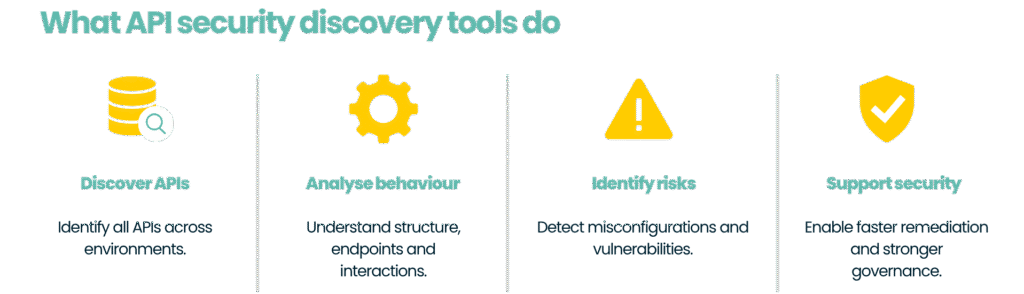
Reconnaissance and API Discovery
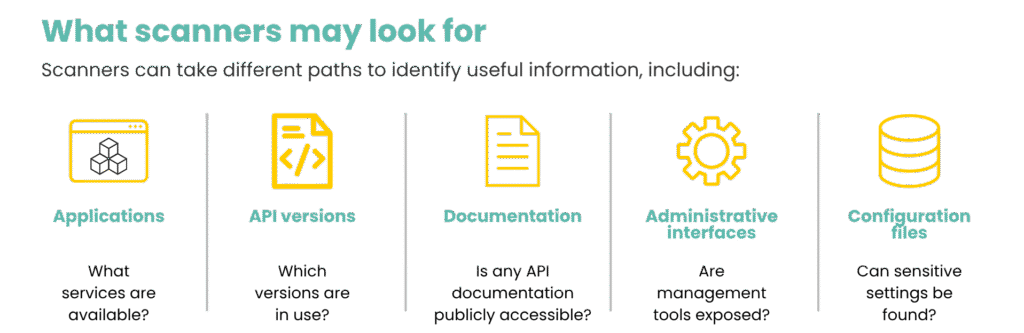
The first stage of an attack can involve simply discovering what is available. In an API environment, publicly reachable endpoints are like the windows and doors of a house. Scanners may test different paths to identify applications, API versions, documentation, administrative interfaces, configuration files or other resources. For example, a request for /.env may be an attempt to determine whether sensitive configuration information has been accidentally exposed. The important lesson is that reconnaissance is about learning before attacking. API security therefore requires organisations to understand not only how they prevent attacks, but also what information their APIs reveal to someone who is looking.
Mapping the API
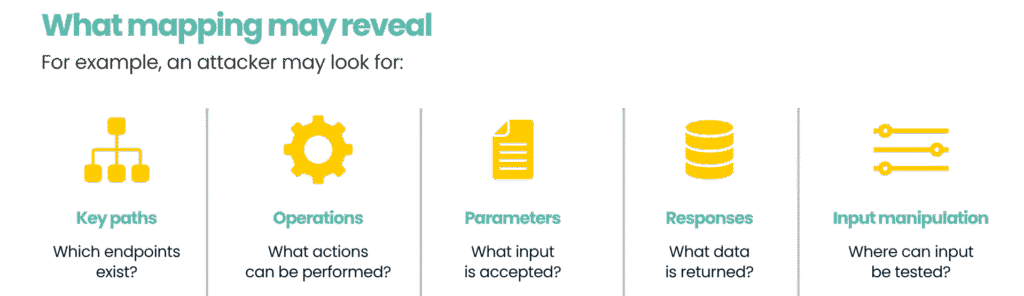
Once an API has been discovered, an attacker may attempt to understand its structure and behaviour. This can include identifying paths, operations, resource identifiers, versions and authentication mechanisms. For example, an endpoint such as GET /api/v1/customers/12345 could be tested with different identifiers to understand how the application responds. This makes API inventory and governance essential. Organisations may have hundreds of APIs across development, pre-production and production, and each should have a clear owner, purpose, security model and lifecycle. An API that nobody knows exists can easily become an API that nobody remembers to secure.
Authentication and Authorisation
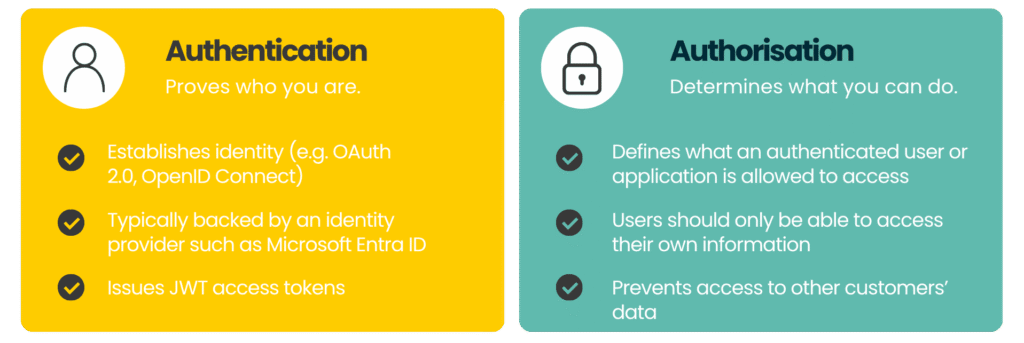
Authentication can be viewed as the lock on the front door of the house. It answers the question, “Who are you?” APIs commonly establish identity through OAuth 2.0 or OpenID Connect flows, typically backed by an identity provider such as Microsoft Entra ID, which issues JWT access tokens. However, authentication alone is not enough. Authorisation determines what an authenticated user or application is allowed to do. For example, a customer may be authenticated successfully but should only be able to access their own information rather than another customer’s data. In simple terms, authentication gets you through the door, while authorisation determines which rooms you are allowed to enter.
Protecting Sensitive Information
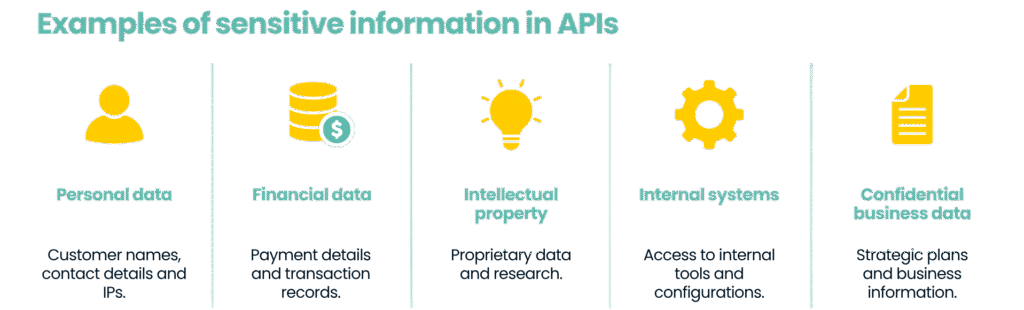
Security also requires ensuring that sensitive information is not accidentally exposed. Attackers may search for configuration files, source-control information, backups, debugging interfaces or credentials. For example, a request for /.git/config may indicate an attempt to determine whether source-control information has been exposed. The principle is simple: if you would not leave your house keys on the windowsill, you should not leave API credentials or other secrets exposed either. Secrets should be managed through appropriate security mechanisms such as secure application configuration, Azure Key Vault and managed identities.
APIM as a Security Boundary
Azure API Management should not be viewed only as a traffic router. It can also act as an important security enforcement point between API consumers and backend services. APIM policies can help enforce authentication, token validation, IP filtering, request validation, rate limiting and quotas. For example, an APIM policy can require a valid access token before allowing a request to reach the backend. This creates an additional security boundary and allows undesirable traffic to be rejected before it travels further into the environment.
Rate Limiting and Abuse Protection
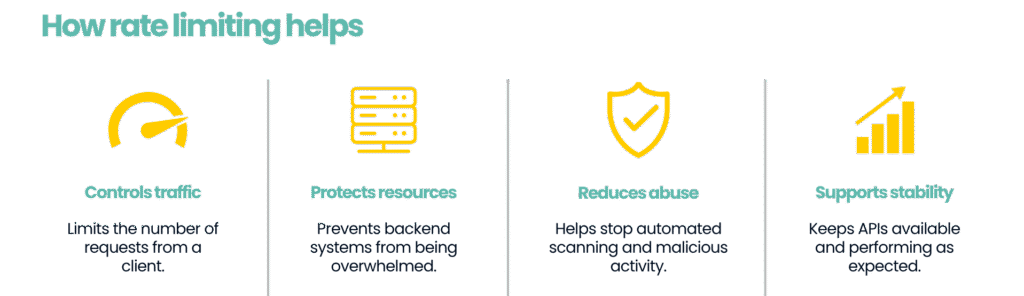
Imagine someone repeatedly trying every door and window of a house. Even if they never get inside, the behaviour may be suspicious. APIs can experience similar behaviour when automated clients send large numbers of requests while testing different endpoints. Rate limiting and throttling can help control excessive traffic, protect backend resources and reduce the impact of automated abuse. For example, a client repeatedly requesting hundreds of different endpoints within a short period could trigger rate-limiting controls. Rate limiting should therefore be considered not only a performance mechanism, but also an important security control.
Monitoring and Understanding 404 Responses
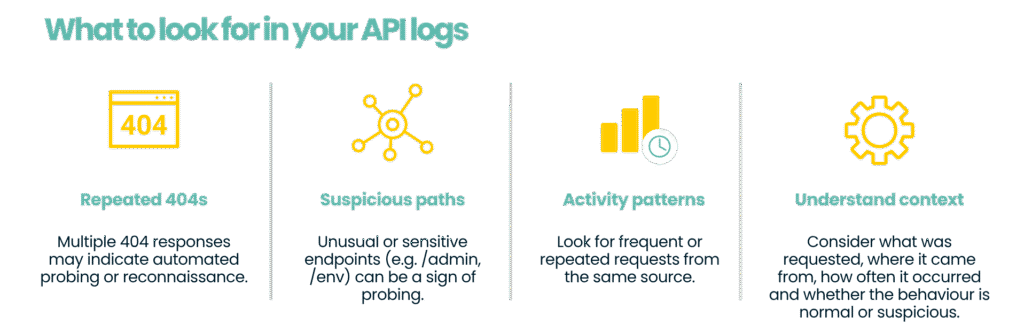
One of the most important lessons from API investigation is that an error does not always mean the same thing. For example, APIM may receive a request that does not match any configured API operation and return a 404 response such as “Unable to match incoming request to an operation.” This is different from a legitimate API operation returning a 404 because a particular resource does not exist. An unmatched request could be a simple mistake, an outdated client, background internet traffic or reconnaissance. A single request does not prove an attack, but repeated requests for configuration files, administrative paths, backups or unrelated technologies provide a stronger indication of automated probing. Context turns an error into security intelligence.

Turning API Logs Into Security Signals
Not every failed request requires investigation. A matched API followed by a backend failure is generally more likely to be an application or operational issue. An unmatched API returning a 404 could represent routing problems, stale clients or reconnaissance. However, an unmatched API combined with suspicious paths and repeated activity becomes a stronger security signal. The objective is therefore not to investigate every 404, but to identify patterns that matter. Effective monitoring should help teams understand what was requested, where it came from, how frequently it occurred and whether the behaviour represents normal traffic or potential reconnaissance.
Security Starts Before Production
API security should begin before an API is exposed to the internet. Organisations should understand what an API exposes, who can access it, how authentication and authorisation are enforced, how secrets are protected, whether rate limits are appropriate, who owns the API and how unusual behaviour will be detected. Automation and governance can make these controls more consistent. CI/CD pipelines can validate API specifications and enforce organisational security and governance requirements before APIs are deployed. This makes security part of the delivery lifecycle rather than something that is considered only after deployment.

The Bigger Lesson
Automated scanning does not necessarily mean that an organisation has been compromised. Publicly accessible systems are continuously scanned across the internet. The important questions are: What are they looking for? What can they discover? What would happen if they found something? And would we know that they were mapping our APIs? Think of your API as a house. Someone may be walking around it, looking through the windows, checking the doors and trying different keys. They may never get inside, but their behaviour can provide valuable information about the security of the environment. Good API security is therefore not only about stopping someone when they break in. It is about knowing what you have, what you expose, who can access it, what they can do, and recognising when someone starts behaving differently. Sometimes the first indication of an attack is not the door being broken down. It is someone quietly looking through the window.
