


By Roby Uanela – DevOps Engineer, Integrove
Imagine living in a state where there are no rules or societal standards. At first, this may sound idealistic, but over time things would inevitably spiral out of control. Without governance, it becomes increasingly difficult to manage people, resources and public services effectively. Chaos eventually replaces order.
The same principle applies to Enterprise Integration.
Throughout my experience working with integration platforms, I have seen how traditional ways of working, particularly those that rely heavily on manual configurations and GUI-based development, allow small but impactful mistakes to slip through unnoticed. APIs are implemented inconsistently, naming standards are overlooked, deployment practices vary between teams, and manual reviews become increasingly time consuming. While these issues may appear minor in isolation, they accumulate over time, leading to inconsistent solutions, deployment surprises and growing technical debt.
This is where governance becomes essential. Governance is not about adding bureaucracy or slowing developers down, it establishes engineering standards that reduce inconsistency, minimise deployment risk and ensure integration solutions can be delivered reliably across teams and environments. The challenge is that governance documents alone are rarely enough, we find that standards are forgotten, manual reviews become repetitive, and as more APIs and development teams are introduced, maintaining consistency becomes increasingly difficult and as a result, manual governance does not scale.
This is where DevOps Engineering changes the game.
By embracing DevOps practices, organisations can move away from GUI-driven development and treat integration assets as code. APIs, policies, workflows and infrastructure become version-controlled artefacts stored in Git repositories, making every change traceable, reviewable and repeatable throughout the software development lifecycle.
More importantly, governance itself becomes code.
Rather than relying on architects and reviewers to manually inspect every API specification, governance can be enforced automatically within the CI/CD pipeline. Every API specification is automatically validated before deployment, ensuring that organisational standards are consistently applied.
Examples of automated governance include validating:
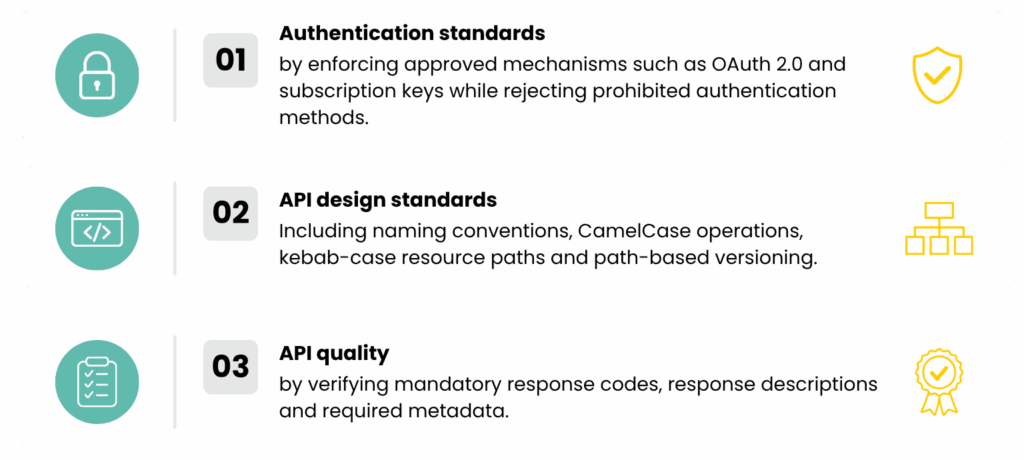
Instead of discovering issues during architecture reviews or after deployment, developers receive immediate feedback while they are still developing the API. The pipeline becomes the guardian of governance, preventing non-compliant solutions from progressing to higher environments.
This approach delivers several important benefits:
- Firstly, it improves the quality of the solutions being delivered. Standards are enforced consistently regardless of team size or developer experience, resulting in APIs that follow the same engineering principles across the organisation.
- Secondly, it improves the developer experience. Developers spend less time performing repetitive manual validation or waiting for reviews that could have been automated. Instead, they receive fast, clear and actionable feedback directly within their development workflow.
- Thirdly, it improves organisational scalability. As more teams and APIs are onboarded, governance does not become a bottleneck because it is embedded into the engineering process rather than relying solely on manual intervention.
In my own work, I have seen how implementing Infrastructure as Code, Git-based workflows and Governance as Code principles can transform the delivery of integration solutions. A developer simply adds a new API specification to a repository, and the pipeline automatically validates the specification against governance standards, previews the deployment and deploys the API into Azure API Management only if every validation succeeds.
The result is a delivery process that is faster, more reliable, more consistent and far easier to scale than traditional approaches.
Good governance should not be viewed as an obstacle to innovation. On the contrary, governance done well enables teams to innovate safely. It removes ambiguity, reduces operational risk and allows developers to focus on solving business problems instead of remembering every standard or best practice.
The future of Enterprise Integration is not simply DevOps, it is Governance as Code.
Organisations that embrace this mindset will be better positioned to deliver integration solutions that are scalable, secure and built to last.
